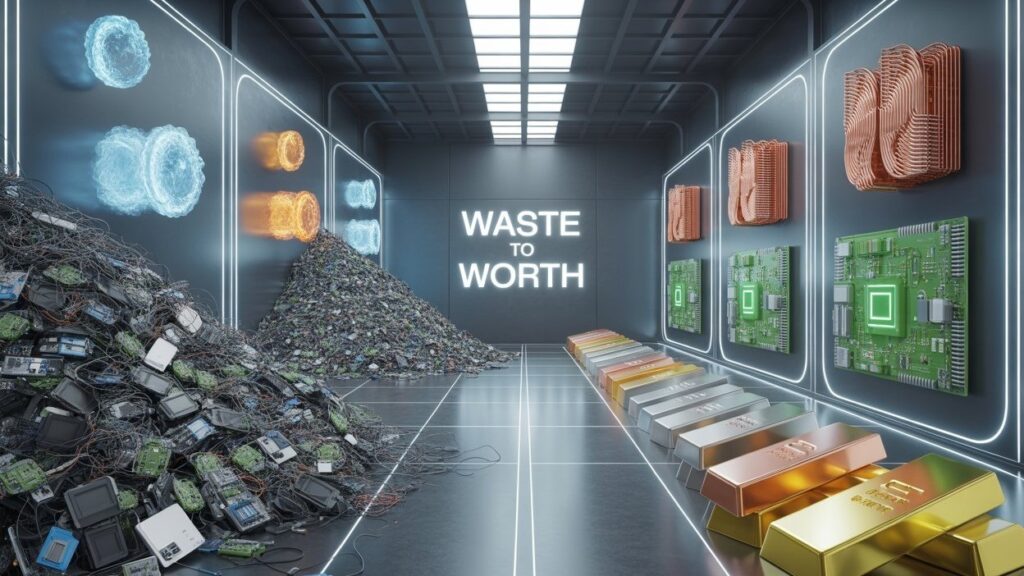
Electronic devices hide more value than most people realise. Printed circuit boards (PCBs), the green boards inside phones, laptops and appliances, contain copper, silver, palladium and even tiny amounts of gold. Recovering those metals is called urban mining, and done right it reduces mining demand, cuts emissions and returns real value to manufacturers. This short, practical guide walks you through a typical PCB recovery flow, why each step matters, and real examples showing the scale and impact.
Why PCB recycling matters
Global e-waste is rising fast: in 2022 the world produced a record ~62 million tonnes of e-waste, yet only about 22% was documented as properly collected and recycled, leaving huge material loss and pollution risk. Recovering metals from PCBs is therefore high-leverage: a single tonne of PCB can contain hundreds of kilograms of copper and grams to kilograms of precious metals that would otherwise need new mining. (E-Waste Monitor)
Collection & pre-sorting, the right input matters
Recovery starts before the plant: quality and safety of incoming material make a big difference. Collections come from corporate e-waste picks, repair shops, and municipal drop-offs. At intake technicians sort by device type (phones, laptops, large appliances) because older boards often have higher precious-metal content. Good sorting improves yields and reduces downstream contamination. (Operational guidance mirrored by large recyclers.) (umicore.com)
Depopulation, remove valuable/ hazardous components
Depopulation is careful component removal: technicians remove mounted parts (ICs, large capacitors, batteries, connectors) using hot-air, hand tools or automated depopulation lines. Batteries and mercury switches are separated for specialist processing; some salvaged components can be refurbished and resold. Depopulation protects downstream equipment and concentrates the metal-rich fractions. Practical guides and EPA handouts outline safe depopulation best practices. (US EPA)
Mechanical processing, shredding, milling and density separation
After depopulation, boards go to mechanical pretreatment: shredders/granulators reduce boards to fragments; trommels, vibrating sieves, magnetic and eddy-current separators segregate ferrous, non-ferrous and non-metal fractions. This step isolates a metal-rich concentrate (often 25–40% metals) that is then routed to metallurgical recovery. Efficient mechanical separation is central to economics, it lowers chemical consumption and increases metal recovery rates. (ourpcb.com)
Metallurgical recovery, hydrometallurgy & pyrometallurgy
This is the “heart” of PCB recycling and where precious metals are extracted:
- Pyrometallurgy: High-temperature smelting reduces and separates metals; leading refiners (e.g., Umicore) operate integrated smelters/refineries to recover dozens of metals from complex e-scrap. (umicore.com)
- Hydrometallurgy: Chemical leaching (acidic or cyanide-free chemistries) dissolves target metals; selective precipitation or ion-exchange recovers gold, silver and palladium. Recent research shows sequential hydrometallurgical flows can be efficient and more controllable for precious-metal recovery. (ScienceDirect)
Modern plants often combine both: mechanical pre-treatment, hydrometallurgical extraction for precious metals, and then refining in conventional precious-metal facilities.
Refining, refining output & quality control
Recovered metal intermediates are refined to market specs (e.g., 99.9% copper, fine gold/silver bars). Quality control, assaying, emissions monitoring, waste neutralisation, is critical: leading recyclers publish their yields and environmental controls to demonstrate compliance. For example, major refineries accept minimum volumes for processing and report recovery ranges for PCBs. (pmr.umicore.com)
Case studies & examples, scale and innovation
- Umicore: global leader in precious-metal recycling: operates integrated smelter/refinery systems designed to recover many metals from e-scrap, accepting defined minimum volumes of PCBs and small IT devices for processing. Their model shows how industrial-scale recovery works end-to-end. (umicore.com)
- Royal Mint (UK) : new precious-metal recovery plant (newsworthy example): its facility aims to process thousands of tonnes of circuit boards a year and recover significant quantities of gold, silver and copper, demonstrating how non-traditional recyclers are entering the field with low-temperature, lower-impact technologies. (Recent coverage outlines expected yields and capacity.) (Financial Times)
- Corporate programs (Samsung et al.): large electronics companies run global take-back and design-for-recycling programs to close material loops and improve collection rates; these programs highlight the importance of upstream design and collection to make the recycling chain efficient. (Samsung)
Environmental & business benefits
- Less mining: recovered metals reduce demand for virgin ore.
- Lower carbon intensity: urban mining often uses less energy per kg of metal than primary mining (life-cycle studies). (hammer.purdue.edu)
- Compliance & revenue: manufacturers and institutions get regulatory proof, and recovered material can offset costs.
Sources & further reading (key references)
- Global E-waste Monitor 2024 — global generation & recycling rates. (E-Waste Monitor)
- Umicore — E-scrap recycling & precious-metals refining — process overview and capacities. (umicore.com)
- Royal Mint Precious Metals Recovery Plant — recent news on large-scale PCB metal recovery. (Financial Times)
- Hydrometallurgical research on sequential PCB metal recovery (ScienceDirect). (ScienceDirect)
- PCB recycling process guides (OurPCB / EPA handouts) — practical steps from depopulation to shredding. (ourpcb.com)